Caring for Punaluʻu, Together
You know as well as I do: Punaluʻu isn’t just a beautiful black sand beach – it’s family. We fish from its shores, our keiki (children) play under the coconut trees, and our kūpuna (elders) share moʻolelo (stories) about the old days when Punaluʻu was full of life. This land has fed us and taught us for generations. And now, it’s calling on us to take care of it. Stewardship here isn’t optional – it’s our shared kuleana (responsibility) as people who love this place.
A History Worth Restoring
Punaluʻu is a place with deep roots and countless stories. For years, this bay thrived with local life – there were jobs for our ʻohana (families), weekends brought big gatherings by the water, and the old village restaurant was filled with laughter and music. The shoreline, the community spaces – they all meant something to those who lived here. If you close your eyes, you can almost see it: aunties and uncles throwing net, kids learning to swim, neighbors trading fruits at the market stand. That was Punaluʻu.
But over time, neglect took its toll. The sugar plantation closed, the little businesses shut down, and no one picked up the kuleana of keeping the area thriving. Bit by bit, the proud village by the bay began to fade. Those bustling gatherings grew rare. Buildings that once served the community started to rust and crumble. What was once a source of pride slowly slipped into disrepair, bringing safety concerns and harm to the land. It hurt to see a place we love so much deteriorating, as if everyone had forgotten it.
Now Punaluʻu is calling to us – not for perfection, but for people willing to care again. The past isn’t gone; it lives in our memories and in the spirit of this place. That history is worth restoring. If we listen, we can hear the echoes of what Punaluʻu used to be – and we can choose to bring that heartbeat back.
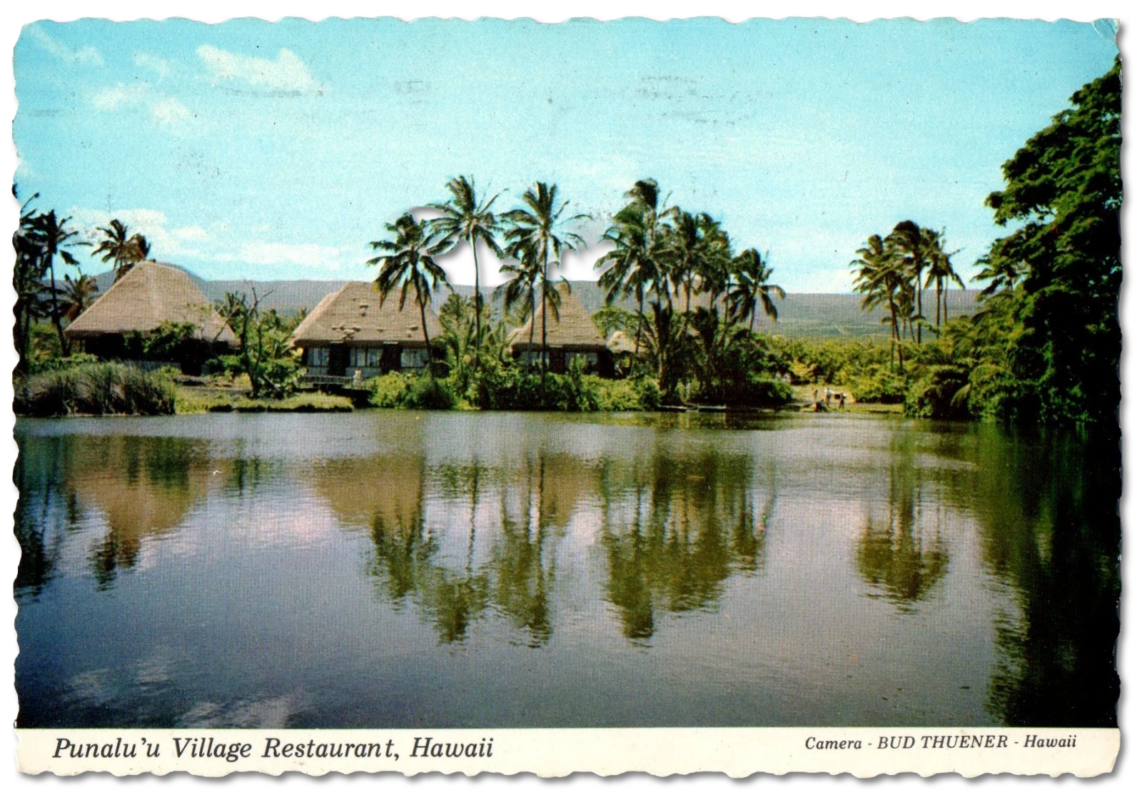
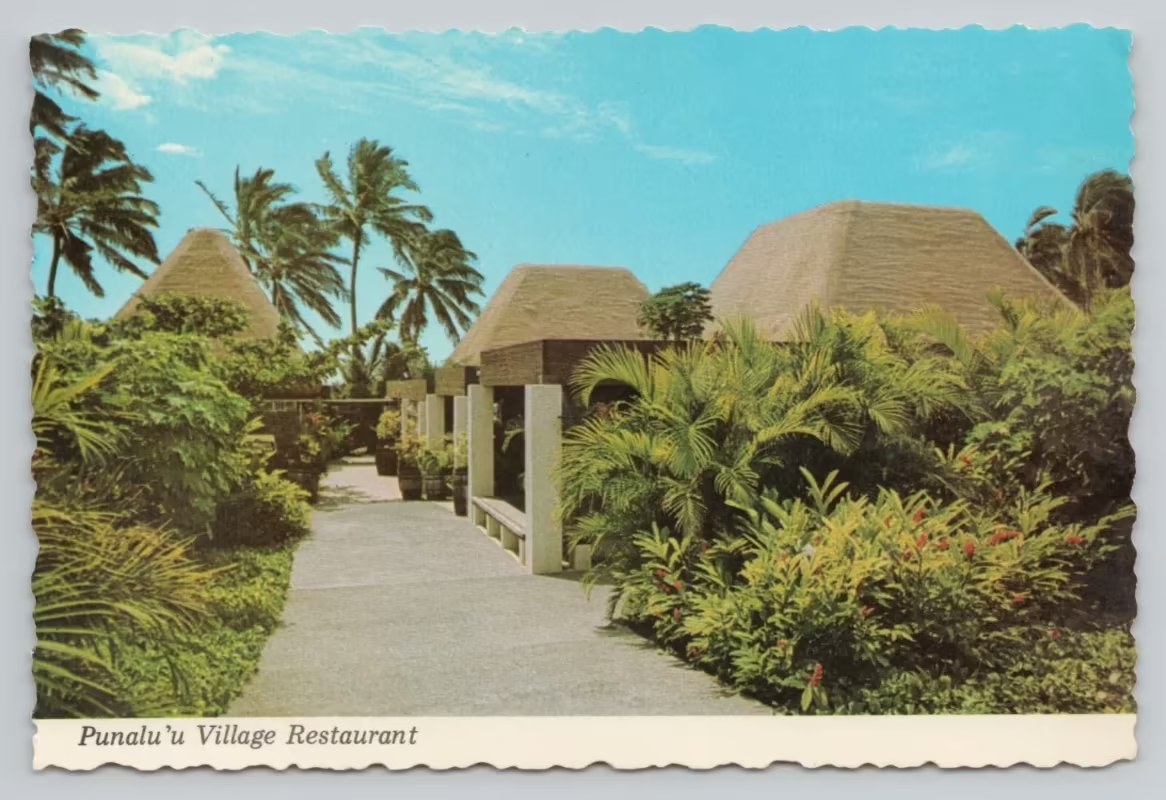
Vintage postcard of Punaluʻu Village Restaurant (circa 1980s) – a reminder of the days when Punaluʻu was full of local life and laughter. Restoring the spirit of those days is part of our kuleana.
We stand at a crossroads between memory and possibility. On one hand, we remember the Punaluʻu that was – and on the other, we imagine what Punaluʻu could be again. By embracing true stewardship, we’re saying yes to that future: one where our keiki can swim in clean waters and learn their grandparents’ fishing traditions; where the land is healthy and giving; and where local families can make a living here at home, instead of having to say goodbye.

VOICES FROM KAʻŪ
When the People Who Live Here Speak
PALIKAPU DEDMAN
Palikapu Dedman, President of the Pele Defense Fund, speaks from a lifetime of advocacy rooted in culture, land, and lived reality in Kaʻū.
His perspective addresses a truth often left unspoken:
“Without jobs, without opportunity, there is no future for our young people.”
Palikapu reminds us that Kaʻū’s economy has long been shaped by tourism — and that pretending otherwise does not protect the land or the people who depend on it.
What matters is how stewardship is practiced.
In his words, the absence of opportunity has already taken its toll:
• Sugar is gone
• Mills are gone
• Local employment is limited
• Families are forced to leave
Preservation, he argues, must be paired with responsible opportunity — or it becomes another form of displacement.
“If people are against jobs, they must offer an alternative.”
His support reflects a belief that community-led stewardship, rooted in culture and guided by long-term care, can protect Punaluʻu while creating dignity and stability for future generations.
Palikapu Dedman
President, Pele Defense Fund
Palikapu Dedman is a cultural and land advocate from the Kaʻū district on Hawaiʻi Island and serves as President of the Pele Defense Fund. Guided by a deep sense of kuleana (responsibility), he has spent many years working to protect Native Hawaiian culture, sacred places, and community land rights—emphasizing the inseparable relationship between people and the ʻāina (land).
He is also one of the few long-time neighbors of Punaluʻu. As a kamaʻāina who grew up in Kaʻū, Palikapu’s connection to this place is rooted in lived experience, memory, and responsibility, shaped by generations of presence rather than abstract ideals.
His perspective reflects a deep understanding that caring for Punaluʻu means honoring both its cultural foundations and its future as a living community.
“Stewardship without opportunity leaves no future for our keiki.”
— Palikapu Dedman, President, Pele Defense Fund
Wayne Kawachi
“When there are no jobs, young people have no choice but to leave.
And when they leave, culture doesn’t survive — it fades.”
“Our number one economy has always been tourism. Tourism isn’t something you can stop — it’s already here.
What matters is how it’s done and who it serves.
For years, there were no jobs in Kaʻū — no sugar mill, limited agriculture, no opportunities for young people.
When there’s no future, our kids leave. That’s the real loss.
Stewardship isn’t just about protecting land.
It’s about protecting people, culture, and the ability for families to stay home.
If we want to mālama ʻāina in a real way, then conservation and opportunity have to exist together.
One without the other doesn’t work.
Decisions about Punaluʻu should come from Kaʻū — from people who live here, raise families here, and care for this place — not from outside voices that don’t carry the weight of this land.”
— Wayne Kawachi, Kaʻū community leader
Wayne Kawachi is one of the most respected community leaders in the Kaʻū region.
Kaʻū Kakou (OKK) is community-based nonprofit organization rooted in the Kaʻū region.
For many years, he has consistently organized and led community volunteers, dedicating long-term and steadfast efforts to the protection of Punaluʻu’s natural environment, cultural heritage, and the broader public interests of the community. He is widely trusted and highly regarded throughout the Kaʻū community.Bruce Wright
“I’ve never seen it maintained this well since I’ve been here.”
Punaluu Colony 1 Resort Resident & Property Owner
“Over the past twenty to thirty years, this is the first time Punaluʻu has been maintained and cared for at this level.”
Bruce Wright has lived at Punaluu Colony 1 Resort for more than three decades. During that time, he has witnessed the full lifecycle of the Punaluʻu Village Restaurant—from its years of vitality, to its closure, and ultimately to its gradual decline. Living through this history has given him a deep, enduring connection to the land and a strong sense of responsibility for its future.
Bruce remembers the old village restaurant—the shared dinners, the gatherings, and a time when the entire Punaluʻu resort was carefully maintained and beautifully cared for. Those memories are not abstract; they are lived experiences that shape how he sees Punaluʻu today and what he hopes it can become again.
As a long-term resident and property owner, Bruce cares deeply about every aspect of this place: the well-being of the nēnē and other native bird species, the safety of sea turtles, the maintenance of critical infrastructure, everyday livability, and the long-term sustainability of the community.
He calls on the community to support the developer’s reasonable, well-planned, and orderly development efforts—so that Punaluʻu’s natural environment can be protected and its infrastructure responsibly maintained for generations to come.
A Perspective Shaped by Time, Not Noise
It’s about listening — and adjusting — with humility.
“She cares about the land.
And that changes everything.”
— Bruce Wright, Kaʻū Resident
“Care You Can See on the Ground.”
“When the Land Is Cared For, Life Returns.”
Keeping Kaʻū Home
Across Hawaiʻi, young families leave not because they want to — but because they have to.
When land is either frozen or exploited, communities fracture.
Punaluʻu is choosing a third path:
one where stewardship includes livelihoods, culture includes continuity, and access remains open.